Author: Jeremy Lim
Published on: 2026-11-27
If you rent out a condo or house in Pattaya to a foreign tenant, there is one important step to complete after handing over the keys: submitting a TM30 notification to Thai immigration.
This requirement can easily be overlooked, particularly by landlords living overseas or renting out their property for the first time. A missing TM30 can lead to fines and cause difficulties for tenants when applying for visa extensions or other immigration services.
This guide explains who is responsible for filing TM30 in Pattaya, how to register online, what documents are required and whether another notification is needed when your tenant travels.
Last reviewed: November 2026.
TM30 is a residence notification required under Section 38 of Thailand's Immigration Act B.E. 2522 (1979). It informs Thai immigration where a foreign national with temporary permission to stay in Thailand is residing.
The owner, householder, possessor or hotel manager must notify immigration within 24 hours of the foreign national arriving at the accommodation.
TM30 applies to condominiums, houses, pool villas, apartments, hotels and private residences. The requirement applies whether the foreign national is paying rent or staying free of charge.
Reporting deadline: Within 24 hours of arrival at the accommodation.
Responsible person: Property owner, householder, lawful possessor or hotel manager.
Applicable properties: Condos, houses, villas and other residential accommodation.
Submission methods: Online or at the relevant immigration office.
Fine for private landlords: Up to ฿2,000.
Local immigration office: Chonburi Immigration on Jomtien Soi 5.
Further information about Section 38 and the 24-hour reporting requirement is available through the Thai government's official TM30 guidance.
For a typical residential rental in Pattaya, the landlord usually arranges the TM30 notification. However, Thai immigration law also recognises the householder or lawful possessor of the accommodation as a responsible person.
The requirement applies to both Thai and foreign property owners.
Property owners do not need to be physically present in Thailand to arrange TM30 registration. Overseas landlords can use the online immigration system or authorize a representative, such as a property manager or real estate agent, to assist with filing.
If an agency is managing your rental, confirm whether TM30 assistance is included before your tenant moves in. Do not assume that condominium management or the rental agent will automatically handle it.
If you are preparing your property for a new tenancy, our guide on how to rent out property in Pattaya covers the wider rental process and responsibilities of property owners.
Foreigners living in their own condominium under temporary permission to stay in Thailand can submit TM30 for themselves as the property owner or lawful possessor. Foreign freehold ownership does not provide an exemption from immigration reporting requirements.
A tenant who qualifies as the lawful possessor of a rented property can also submit TM30, although supporting ownership documents or authorization from the landlord may be required.
Both parties should agree on who will handle the notification before the tenant moves in. For more information about rental responsibilities, read our guide to rental agreements in Thailand.
Landlords must generally submit TM30 within 24 hours of a foreign tenant arriving at the property.
For example, if a tenant signs a rental agreement on Monday but moves into the condominium on Friday, the reporting deadline begins when they arrive at the accommodation on Friday.
A new notification is required when a new foreign tenant moves in or an existing tenant relocates to another property.
Whether a new TM30 is required after leaving and returning to Thailand depends on the tenant's visa type, immigration status and existing residence notification.
Under the revised Royal Thai Police regulation effective from 30 June 2020, foreign nationals returning to the same registered accommodation within the previously notified stay period may not need to submit another TM30.
PropertySpace consulted an immigration officer to clarify how this requirement applies in practice. Landlords should pay particular attention to the tenant's visa type and permission to stay when arranging TM30 after overseas travel.
Long-term visa holders: A new TM30 is generally not required when the tenant returns to the same registered accommodation under qualifying immigration conditions and the existing notification remains valid.
Tourist visa holders: A new TM30 should generally be submitted when the tenant returns to Thailand under a new permission to stay.
Visa-exempt visitors: A new entry into Thailand under visa exemption will generally require a fresh residence notification.
Holders of re-entry permits or multiple-entry visas: Another TM30 may not be required when returning to the same accommodation, provided the conditions of the existing notification are met.
Domestic travel within Thailand: Another TM30 is generally unnecessary when the tenant returns to the same registered accommodation within the previously notified stay period.
Moving to another property: A new TM30 must be submitted when the foreign national moves to a different residential address, regardless of visa type.
Renewing a rental agreement: Check whether the previously notified accommodation period remains valid or needs updating.
Landlords should check their tenant's latest immigration status after overseas travel rather than assume that the previous TM30 remains valid. The exact reporting requirement may depend on the circumstances of their return.
The national regulation is explained in this legal summary of Thailand's revised TM30 requirements by Tilleke & Gibbins.
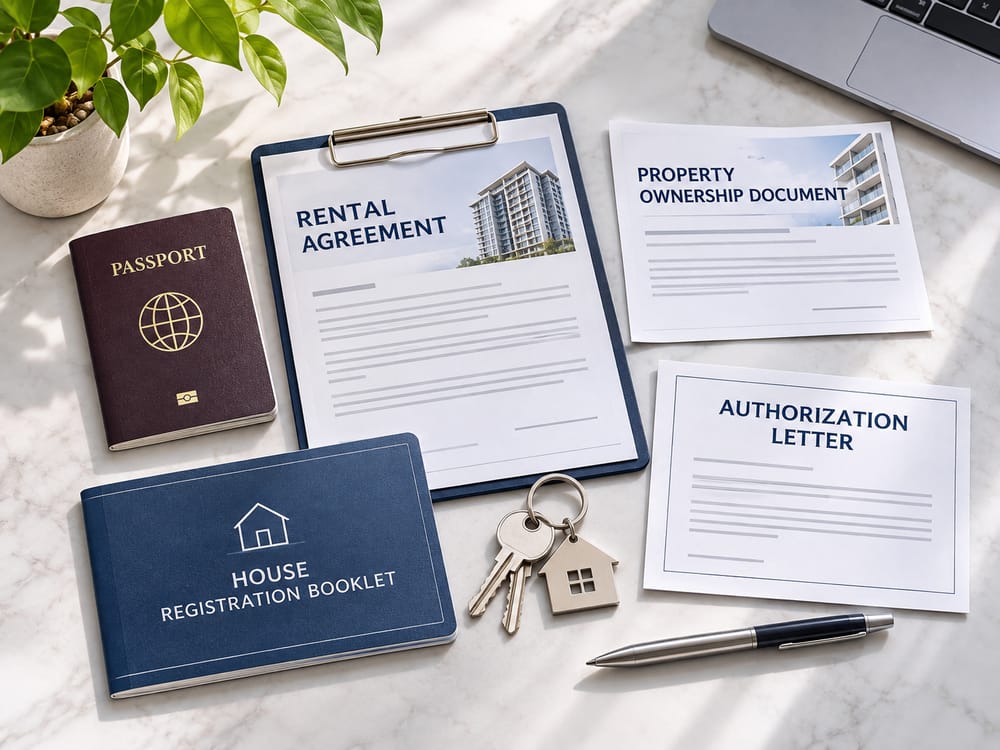
The documents required depend on whether you are registering a property for the first time, reporting a new tenant or submitting the notification through an authorized representative.
Commonly requested documents include:
- Thai national ID card or passport of the property owner.
- Title deed or other proof of property ownership or lawful possession.
- House registration book (Tabien Baan), where applicable.
- Signed rental agreement.
- Signed authorization or power of attorney, if using a representative.
- Passport identification page.
- Passport number and nationality.
- Most recent arrival date in Thailand.
- Visa or permission-to-stay details, where required.
- Actual move-in date.
- Expected length of stay or departure date from the accommodation.
Additional documents may be requested depending on the property ownership structure, submission method and local immigration requirements.
Preparing these documents before the tenant moves in helps landlords meet the 24-hour reporting deadline.
Landlords can submit TM30 through the official online immigration system or in person at the relevant immigration office.
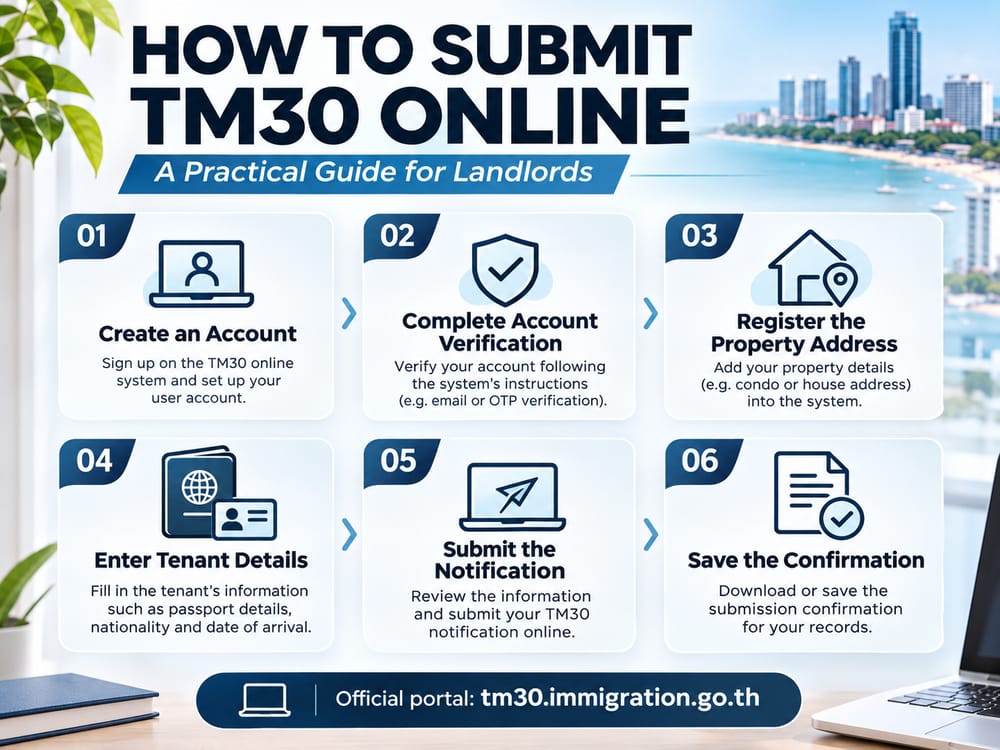
Online registration is generally the most convenient option, particularly for overseas landlords and owners managing several rental properties.
Visit the official Thai Immigration Bureau TM30 portal.
The general registration and reporting process is as follows:
- Create an account using your identification and contact information.
- Complete any required account verification.
- Register the accommodation address and provide supporting documents as requested.
- Enter the foreign tenant's passport and accommodation details.
- Review the information and submit the TM30 notification.
- Save the notification record and provide a copy to your tenant.
Registering an account or adding a property to the system does not automatically complete TM30 reporting. You must also submit a residence notification for the foreign national staying at the property.
If you are using the system for the first time, register your accommodation before the tenant's scheduled move-in date.
Landlords with properties within the local office's jurisdiction can submit TM30 in person at:
Chonburi Immigration Office (Pattaya) Jomtien Soi 5, Nong Prue, Bang Lamung, Chonburi, Thailand.
Bring the completed TM30 form together with the relevant landlord, property and tenant documents.
An authorized representative can also assist with submission, subject to immigration's documentation requirements.
Keep the acknowledgment of the notification for your records and provide a copy to your tenant.
For current local procedures, visit the Chonburi Immigration website or contact the Immigration Bureau hotline at 1178.
Under Section 77 of Thailand's Immigration Act, private landlords and other responsible persons who fail to comply with Section 38 can face a fine of up to ฿2,000.
Hotel managers are subject to fines ranging from ฿2,000 to ฿10,000.
A missing TM30 can also cause difficulties for foreign tenants when applying for visa extensions, certificates of residence or other immigration services requiring address verification.
If you discover that your tenant's TM30 has not been submitted, arrange to complete the notification as soon as possible using accurate arrival and accommodation information. Immigration may impose a fine for late reporting.
Foreign tenants should request a copy of their TM30 confirmation after moving in and keep it alongside their rental agreement.
If you are new to the local rental market, our guide to renting in Pattaya explains the documents, deposits and arrangements tenants should check before committing to a property.
TM30, TM47 and the Thailand Digital Arrival Card (TDAC) are separate immigration procedures. Completing one does not replace the others.
TM30 — Residence Notification
Reports the accommodation address of a foreign national staying in Thailand. It is the responsibility of the property owner, householder, lawful possessor or accommodation provider.
TM47 — 90-Day Reporting
Reports the continued residence of a foreign national staying in Thailand for 90 consecutive days, where applicable. This is generally the foreign resident's responsibility.
TDAC — Thailand Digital Arrival Card
Provides arrival information before entering Thailand for applicable foreign travellers. The Thailand Digital Arrival Card replaced the traditional paper TM6 arrival card from 1 May 2025.
Submitting a TDAC does not remove the landlord's TM30 reporting obligation. Similarly, completing TM30 does not replace the tenant's 90-day reporting requirement.
To avoid unnecessary immigration problems during a tenancy, landlords should follow these steps:
- Establish who will handle TM30 before the tenant moves in.
- Prepare the property ownership and tenant documents.
- Register the accommodation online, if necessary.
- Submit TM30 within 24 hours of the tenant's arrival.
- Provide the tenant with a copy of the notification.
- Review the existing TM30 when the tenant changes address, returns from overseas or their immigration circumstances change.
Keep the TM30 confirmation together with the signed rental agreement so that both parties can access it when needed.
At PropertySpace, we help landlords rent out condominiums, houses and pool villas across Pattaya, Jomtien, Pratumnak, Wongamat, East Pattaya and Huay Yai.
If you are preparing to rent out your property, explore our current properties for rent in Pattaya or contact our team for assistance with rental pricing, property marketing, tenant placement and rental handover arrangements.
PropertySpace — Pattaya Real Estate
Website: www.propertyspace.co.th
LINE: @PropertySpace
Email: [email protected]
Phone: +66 89 714 1551
This guide provides general information about Thailand's immigration reporting requirements. Visa-specific requirements and local administrative procedures may change. Contact the relevant immigration office for guidance regarding individual circumstances.
TM30 is a residence notification required under Section 38 of Thailand's Immigration Act B.E. 2522 (1979). It informs Thai immigration of the accommodation address of a foreign national staying temporarily in Thailand.
The property owner, householder, lawful possessor or hotel manager is responsible for submitting TM30 under Thai immigration law.
A TM30 notification must generally be submitted within 24 hours of a foreign national arriving at the accommodation. The deadline begins from the actual arrival at the property, not the date the rental agreement was signed.
Yes. Landlords can submit TM30 through the official Thai Immigration Bureau portal at tm30.immigration.go.th after completing account and accommodation registration. Property owners living overseas can also use the online reporting system.
TM30 can be submitted online or at Chonburi Immigration on Jomtien Soi 5, Nong Prue, Bang Lamung, for properties within its jurisdiction.
Under Section 77 of Thailand's Immigration Act, private landlords and other responsible persons can face a fine of up to ฿2,000 for failing to submit TM30. Hotel managers face fines ranging from ฿2,000 to ฿10,000.
TM30 reporting after re-entering Thailand depends on the foreign national's visa type and immigration status. Long-term visa holders returning to the same registered accommodation generally do not need a new TM30 if the applicable reporting conditions are met. Tourist visa holders and visa-exempt visitors entering under a new permission to stay should generally have a new TM30 submitted within 24 hours of arriving at their accommodation.
Yes. A tenant who qualifies as the lawful possessor of the accommodation can submit TM30 if the required documentation and registration conditions are met. Supporting property ownership documents or authorization from the landlord may be necessary.

Jeremy Lim
Real Estate Agent
Avoiding Rental Scams in Pattaya: What to Look Out for When Renting (2026 Guide)
Learn what to look out for when renting in Pattaya in 2026, including common rental scams, agent risks, and contract mistakes to avoid.

Best Areas to Buy a House in Pattaya 2025 | PropertySpace Pattaya Guide
Discover the best areas to buy a house in Pattaya in 2025, from family-friendly neighborhoods to premium villa zones.

Best Areas to Live & Buy Property in Pattaya — PropertySpace Neighborhood Guide
Looking for the best areas to live or buy property in Pattaya? Discover lifestyle insights, expat favorites, and expert guidance from PropertySpace.
Best Modern Condos in Jomtien (2026 Guide for Foreign Buyers)
A practical 2026 guide to the best modern condos in Jomtien for foreign buyers and expats, featuring beachfront, lifestyle, and long-stay condominium options.

Best Pattaya Properties for Sale: Condos, Houses & Villas
Explore the best Pattaya properties for sale, including condos, houses, pool villas, top areas, prices, and buying tips for foreign buyers.

Best Real Estate Agency in Pattaya 2025 | PropertySpace Guide
Discover how to find the best real estate agency in Pattaya. Expert tips and trusted local insight from PropertySpace Pattaya.

Buying a Condo or Villa in Pattaya: The Ultimate Guide for Expats
Navigating the legal landscape is essential when buying property in Pattaya as an expat.

Can Foreigners Buy Property in Pattaya? A Comprehensive Guide
Understanding Property Ownership for Foreigners in Thailand

Discover the Luxurious Lifestyle at Zenith Pattaya: A Wellness-Centered Paradise
Pattaya's First Wellness-Centered Living Experience

Highgate International School Pattaya | Property Investment Guide
Discover how Highgate International School Thailand boosts Pattaya’s real estate market and property investment opportunities.
How to Buy a Condo in Thailand as a Foreigner: Step-by-Step Process (2026 Guide)
A practical 2026 guide for foreigners buying a condo in Thailand, covering foreign quota, FET, costs, contracts, and transfer steps clearly.
How to Rent Out Property in Pattaya: 2026 Landlord Guide
Learn how to rent out property in Pattaya as a foreign owner, including TM30, tenant screening, rental pricing, tax and property management.
How to Sell a Condo in Pattaya as a Foreign Owner
A practical guide for foreign condo owners in Pattaya covering resale pricing, documents, taxes, transfer fees and sending sale proceeds overseas.

International School Fees in Pattaya: Costs & Where to Live
Compare international school fees in Pattaya for 2026–2027, including Regents, Rugby School Thailand and Tara Pattana. Discover tuition costs, entrance fees and the best areas to live near international schools.
International Schools in Pattaya: Complete Guide for Expat Families
Explore international schools in Pattaya, curriculum options, fees structure and best areas for expat families relocating to Thailand.

Leasehold vs Freehold in Pattaya: What Foreign Buyers Should Actually Know Before Buying
Understand leasehold vs freehold in Pattaya for foreign buyers. Learn the real differences, legal risks, resale impact, and which ownership type may suit your goals.

Luxury Coastal Living at Aquarous Jomtien Condominium, Pattaya
Discover Aquarous Jomtien Condominium, a stunning high-rise development in Jomtien Pattaya, offering breathtaking 85% sea-view units, world-class amenities, and luxurious living spaces.

Off-Plan Condos in Pattaya: A Wise Investment or a Risky Bet?
This article aims to guide you through the ins and outs of investing in off-plan condos in Pattaya.
Pattaya Smart City: How AI CCTV Is Making Pattaya a Safer Place to Live, Visit, and Invest
Pattaya Smart City is transforming Pattaya through AI CCTV, Pattaya Connect, and smarter public safety systems, helping create a safer city for residents, tourists, and property investors in 2026.

Property Inspection Pattaya: What Buyers Should Really Check Before Taking Ownership (2026)
Learn what buyers should really check during a property inspection in Pattaya, including common issues, timing, and new vs resale considerations.
Rental Agreement Thailand: What Pattaya Tenants Should Check Before Signing
Understand rental agreements in Pattaya, including deposits, lease terms, utilities, repairs and what tenants should check before signing.
Renting in Pattaya: What to Know Before You Rent
Everything you need to know about renting a condo, house, or pool villa in Pattaya — best areas, costs, documents, and what your rental agent actually does.
Thailand Elite Visa vs Retirement Visa: Which Is Right for Pattaya Property Buyers in 2026?
Thinking of buying property in Pattaya and staying long-term? This guide compares the Thailand Retirement Visa and the Thailand Privilege Card (Elite Visa) — covering costs, requirements, and which long-stay visa suits your lifestyle and budget in 2026.

The Riviera Beverly Hills Residence: Pattaya’s New Luxury Condo Investment Opportunity
Discover The Riviera Beverly Hills Residence, a luxury low-rise condo in Jomtien. Perfect for investors, expats & families seeking a Pattaya property.

The Riviera California - Iconic Living For The Few
Luxury Sea View Condos in Pattaya with 5-Star Concierge & Iconic Rooftop Pools | 122 Residences Only

The Riviera Santa Monica: Luxury Living Meets California Vibes in Jomtien, Pattaya
Discover The Riviera Santa Monica, an extraordinary 7th high-rise condominium by the award-winning Riviera Group.

Top 5 Condos in Pattaya 2025 | Best New Projects & Investment Guide
Discover Pattaya’s top 5 condo projects for 2025 — verified developments, investment potential, and local insight from PropertySpace.

Top Luxury Villas in Pattaya 2025 | PropertySpace Pattaya Guide
Explore Pattaya’s top luxury villa estates and pool villas in 2025 — gated communities, prime areas, and trusted insights from PropertySpace Pattaya
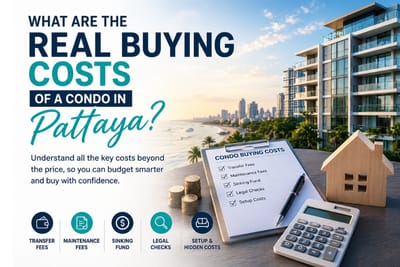
What Are the Real Buying Costs of a Condo in Pattaya?
Understand the real buying costs of a condo in Pattaya, including transfer fees, maintenance fees, sinking fund, legal checks, and hidden costs buyers often miss.

Where to Buy a House in Pattaya as a Foreigner (2026 Practical Guide)
A practical 2026 guide for foreigners buying houses in Pattaya, covering the best areas, ownership options, and real-life buying considerations.
Why Pattaya Attracts Long-Stay Residents, Retirees and Second-Home Owners in Thailand
Discover why Pattaya attracts long-stay residents, retirees, and second-home owners seeking coastal living, convenience, and lifestyle flexibility
Why Pattaya is the Ideal Destination for Retirement
Discover why Pattaya is the ideal place to retire in Thailand
Why Pattaya Property Looks Stronger in 2026: EEC Growth, 3 Million Baht Condo Rules, and What Foreign Buyers Should Know
Pattaya property in 2026 is being shaped by EEC growth, stronger infrastructure, Aquatique District, and the 3 million baht condo extension support route. This guide explains what foreign buyers should understand before investing.

089 714 1551 (ENG/TH)
Call Now081 969 4950 (ENG/CN)
Call Now